
Here’s How Much Extra Energy a Gnarly Trail Burns
“],”renderIntial”:true,”wordCount”:350″>
Here’s a new term for the path working entire world: technicity. In a latest analyze on uphill path working, the expression ground technicity refers to roots and rocks, sand and mud, slipperiness, unevenness, and all the other characteristics that distinguish an appealing path from a simple outdated road or monitor. It is borrowed from the French term technicité, indicating “technical high-quality or character,” and was initial utilized in English in a 1933 newspaper report paraphrasing a dispute amongst two French socialist politicians. It is a little bit uncomfortable, but I simply cannot consider of any much better solutions. Technicality, for instance, has a bunch of other connotations (like “loophole” or “meaningless detail”).
So, with the terminology settled, how does the technicity of a path influence the way you operate up it? Which is what François Nicot of the Université Savoie Mont Blanc and his colleagues at several other universities in France set out to establish, publishing their success in the European Journal of Activity Science. They had ten volunteers operate up two trails, a person with reduced technicity and the other with high technicity. Then they replicated individuals runs on a treadmill, matching the slope, length, and speed in a hundred-meter (328-foot) increments, in order to determine out how their strides adjusted and how considerably more electricity the specialized trails burned.
Each trails were being on the eastern aspect of Montagne-du-Chat, in the Savoie region of France. Just about every segment was about one,000 meters very long (a small a lot more than 50 % a mile), with relatively continuous slopes to prevent sudden jumps in energy, and took about ten minutes to finish. The reduced technicity path climbed 190 meters (623 ft), and the high technicity path climbed 200 meters (656 ft). In case your intuition for what constitutes reduced and high technicity is a small rusty, here are pictures of the two (with high technicity on the still left):
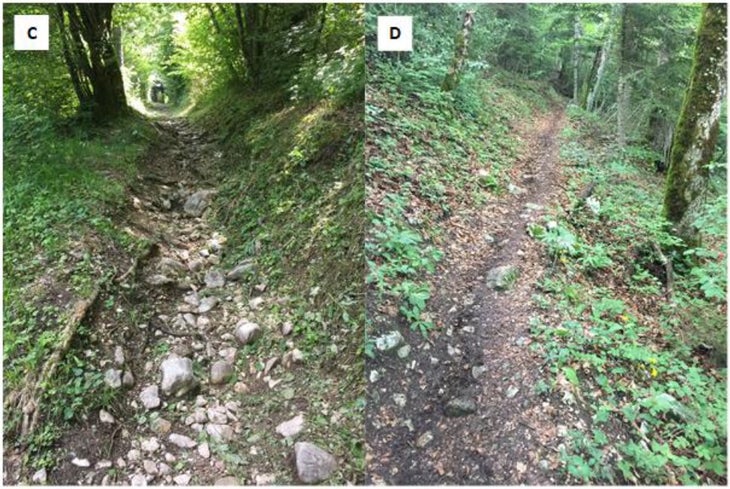
So what’s the difference amongst working on sleek vs . specialized terrain? In phrases of biomechanics, the largest a person is the quantity of aspect-to-aspect motion. The magnitude and variability of aspect-to-aspect foot accelerations a lot more than doubled on the trails in comparison to the treadmill, with very similar will increase for both of those trails. Cadence (the selection of ways for each minute) was considerably less influenced. On the reduced technicity path, there was no sizeable difference in comparison to the treadmill. On the high technicity path, cadence was 4.six % lower, presumably simply because the runners were being sometimes stretching out their stride to get over a root or rock.
The runners wore a coronary heart-rate check, a GPS view, and a respiratory mask related to a metabolic analyzer to evaluate their electricity expenditure. Not amazingly, oxygen consumption (a proxy for electricity) was larger on the trails than on the treadmill. But there wasn’t a sizeable difference amongst the two technicities: the simple path burned ten.4 % a lot more electricity than its treadmill analog, while the tough path burned eleven.4 % a lot more. The coronary heart rate values adopted a very similar sample.
In contrast (and amazingly), there was no clear difference amongst treadmill and trails for perceived energy. There are a number of factors that the treadmill runs may have felt just as tough even nevertheless the physiological measurements recommended they were being less complicated. Just one is that treadmill working lacks the cooling airflow of overground working. But a more simple a person, the scientists point out, is that most people locate working on a mountain path quite pleasant in comparison to slogging away on a treadmill in a lab. That pleasure difference may have bled into the subjective rankings of energy.
In the end, the conclusion that specialized path working is more difficult than sleek-surface working won’t shock any one. Earlier research had believed that working on stage ground over simulated uneven terrain on a treadmill burned about five % a lot more electricity than sleek terrain. The new research implies ten % on uphill trails—but the difference may have a lot more to do with the outside location, which permits rougher terrain and a lot more aspect-to-aspect motion than a treadmill, than with the uphill slope. These quantities start out to give us a sense of just how considerably slower we need to be expecting to operate on tough trails—and they hint at the prospect of a courageous new entire world, numerous scientific studies into the upcoming, the place well-liked routes and path races include a new term into their vocabulary and market their scientifically validated technicity rating.
For a lot more Sweat Science, be part of me on Twitter and Facebook, indicator up for the email newsletter, and test out my ebook Endure: Intellect, Physique, and the Curiously Elastic Restrictions of Human Efficiency.


